



Framed or unframed, desk size to sofa size, printed by us in Arizona and Alabama since 2007. Explore now.
Shorpy is funded by you. Patreon contributors get an ad-free experience.
Learn more.



- If You’re Like Me, Never
- U.S.A.
- S&P
- 1940 Zenith radio model 6G601
- Quality goes in before the name goes on!
- Snazzy skirt
- Carbon Arc Lamps
- Illuminate us
- I remember it well
- I can't prove it
- Complicated then, forgotten now
- Bryan-Stevenson
- Skinny is as skinny does
- How do you rest in peace
- Riding the footboards
- Alas, hidden from view
- Baldwin Diesels
- Exclusive pump
- Bananas, Oysters and Smokey Joe
- Details, Details
- What's that building to the left of the tower?
- Coal Barges
- Bromo-Seltzer
- Inner harbor
- The Basin
- What a headache!
- Giant stepladder?
- Yeah, it was cold
- Love those coats
- Link & Pin Days Remnant

Photos submitted by Shorpy members!
Print Emporium









Dutch Gap: 1864
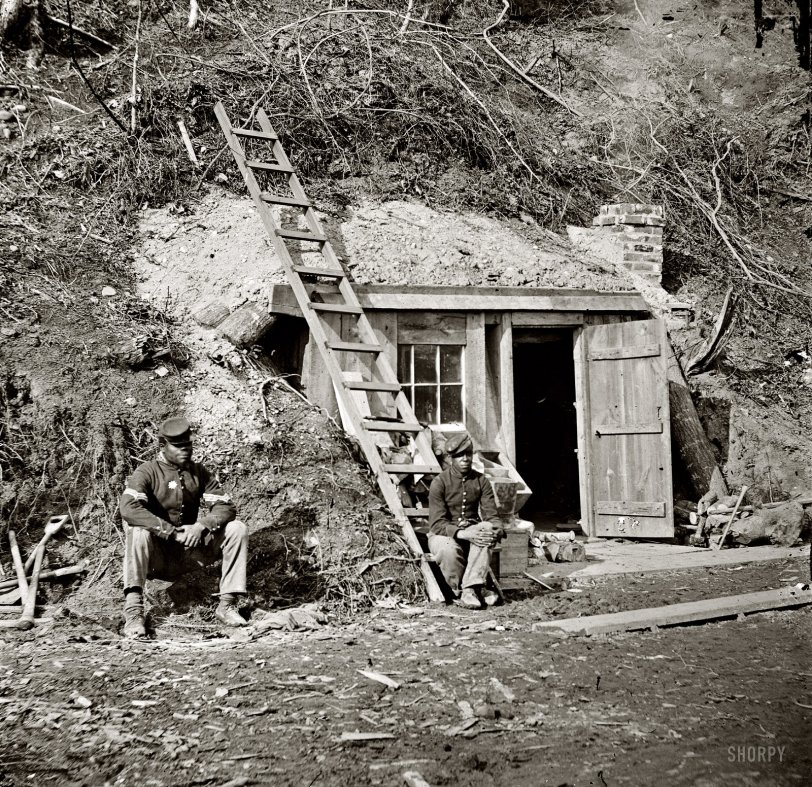
November 1864. "Dutch Gap, Virginia. Bomb-proof quarters of Major Strong." Wet plate glass negative from photographs of the main Eastern theater of war, the Army of the James, June 1864-April 1865. View full size.
In Charge
You've got to be glad to see these guys in uniform. Especially the soldier on the left has the look of a person with real dignity. Was he a former slave? Most probably, but he certainly looks like he is fully in charge of the situation.
Nice to see that was documented!

Bombs Bursting In Air
As Susan pointed out, a well placed cannonball would have take that place out, however that wasn't the purpose and I'm guessing that this was nowhere near to a place where a cannonball could get at it.
In simple terms a cannonball is a direct-fire weapon - you aim your cannon at something and let fly. So, if you're entrenched, as at the Siege of Petersburg, which I believe included Dutch Gap, you avoid cannonballs by digging your shelter into the wall of your trenches facing the enemy.
A bomb is different. In the Civil War this would have been a hollow iron shell (probably ball shaped) packed with explosives and maybe some other nasty scrap metal. This would have a fuse attached. The bomb would arc through the and explode - hopefully over the enemy positions - where the iron of the shell, and whatever nasty stuff was inside would spread about in nasty chunks designed to kill and maim. The defense is to dig into a hillside and build a rudimentary entryway. The only thing that surprises me about this is that the Major actually allowed himself the luxury of a glass window. Glass shards can be as deadly as a chunk of iron. I suppose if the business part of the bomb-proof is far enough back that wouldn't be a problem.
Bombs during the Civil War
I'm no weapons expert, but a well-placed cannonball would have taken that place in a heartbeat.
 Shorpy.com is a vintage photography site featuring thousands of high-definition images. The site is named after Shorpy Higginbotham, a teenage coal miner who lived 100 years ago. Contact us | Privacy policy | Accessibility Statement | Site © 2024 Shorpy Inc.

On Shorpy:
Today’s Top 5