



Framed or unframed, desk size to sofa size, printed by us in Arizona and Alabama since 2007. Explore now.
Shorpy is funded by you. Patreon contributors get an ad-free experience.
Learn more.




- Details, Details
- What's that building to the left of the tower?
- Coal Barges
- Bromo-Seltzer
- Inner harbor
- The Basin
- What a headache!
- Giant stepladder?
- Baldwin 62303
- Baldwin VO-1000
- Cold
- No expense spared
- Tough Guys
- Lost in Toyland
- And without gloves
- If I were a blindfolded time traveler
- Smoke Consumer Also Cooks
- Oh that stove!
- Possibly still there?
- What?!?
- $100 Reward
- Freeze Frame
- Texas Flyer wanted
- Just a Year Too Soon
- WWII -- Replacing men with women at the railroad crossing.
- Yes, Icing
- You kids drive me nuts!
- NOT An Easy Job
- I wonder
- Just add window boxes
Photos submitted by Shorpy members!
Print Emporium





D-Day: New York
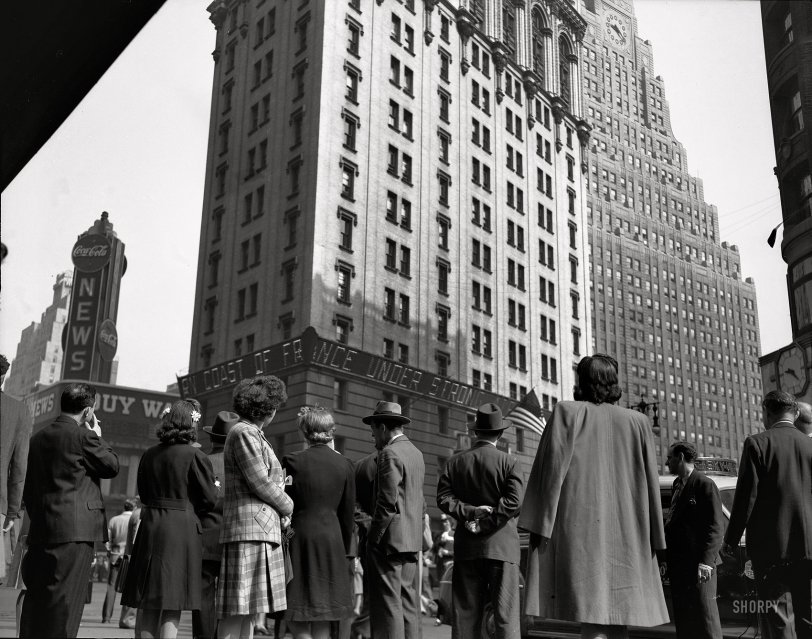
New York, June 6, 1944. ALLIED ARMIES LAND ON COAST OF FRANCE. GREAT INVASION OF CONTINENT BEGINS. "D-Day. Crowd watching the news line on the New York Times building at Times Square." Photo by Howard Hollem or Edward Meyer for the Office of War Information. View full size.
Full message
I believe the full message read: "ALLIES LAND ON NORTHERN COAST OF FRANCE UNDER STRONG AIR COVER"

Hovercraft tanks, sort of
One of many unique innovations for the D Day invasion was the "Duplex Drive" tank, essentially a standard Sherman tank which was fitted with an inflatable, collapsible canvas screen and twin screw props which would enable the tank to float like a boat and wade ashore.
Unfortunately, the contraption worked best in calm water, something that was in short supply off the Normandy coast that day. I remember a buddy of mine whose dad had served with the US Navy at the invasion re-telling his dad's stories of the DD tanks being dropped off in deeper, rough water due to enemy fire and sinking like rocks.
Fortunately enough of the tanks were able to make it on shore to provide badly needed armor support for the ground troops, and the tanks were deemed successful enough to serve in the invasion of Southern France two months later, as well as during numerous river crossing operations during the remainder of 1944 and 1945.
Good article with photos of the tanks:
Cold for June
I realize most people dressed up in public back then, but most of the women in the photo are wearing overcoats. It must have been cold in New York that June day in 1944.
Hovercraft at D-Day
@sjack: I don't mean to rain on your parade, and I certainly don't wish to denigrate the memory of your father and his courageous service to our nation in World War II, but I'm quite sure he didn't lower tanks onto hovercraft for the D-Day invasion of Normandy. The US Army did not make use of hovercraft until Viet Nam, and then it was only on an experimental basis. As your comment is titled, memories are funny sometimes.
Perhaps your dad talked about loading tanks onto landing craft, not hovercraft, like the LST (landing ship tank) or smaller versions like the LCU (landing craft utility), which were flat-hulled vessels that could approach fairly close to the beach and lower a ramp on the bow, allowing troops and vehicles to exit.
Memories are funny sometimes
My father was on a supply ship in the English Channel on D Day, lowering tanks into hovercraft that were being sent to French beach heads. Many, many, times I tried to discuss his experiences that day but he never really had much to say. He said that on D Day he was "on the water" (in the Channel) and they were pretty much working constantly getting the tanks loaded and shipped. They slept whenever they could he said. He landed at Utah beach (but didn't say when) and moved up the coast doing whatever was asked (he was in a supply unit) until he got to Belgium. And that was pretty much all I got out of him. His shared memories of the battle of the Bulge were even more meager ("it was very cold"). I'm jealous of people whose fathers discussed their war experiences; mine just didn't seem to want to share.
May we never forget
how brave these men were. My uncle fought in Okinawa in 1945, unfortunately he never made it out alive. I still have the last letter he wrote to his "beloved mama", what a sweet soul he was. Bless them one and all.
Yeah, I remember.
Although we didn't know it at the time, my brother was in the sand of Utah Beach just then. He survived the war. I remember vividly the headlines in The Detroit Times that afternoon, "WE WIN BEACHES". Due to the time difference, of course, there was plenty of fresh news of the invasion in the afternoon paper. I've been a news junkie since.
Thanks! Uncle Sam
My uncle Sam (no pun intended) landed at Omaha Beach, and immediately sustained an injury to his head. He was fitted with a metal plate to replace the part of his skull that he lost. Needless to say, his fighting days were over.
However, he went on to be become an accomplished auto mechanic. Family, friends, and neighbors all asked him for automotive advice.
He passed away last year at the age of 90.
Thanks, Uncle Sam! - because of your sacrifices, I am free today to write this.
The Bronx is up but the Battery's down
"New York, New York, A Helluva Town" was sung in the Broadway "On the Town" but for the film changed to "New York, New York, A Wonderful Town" because of those archaic Hollywood codes at that time. Los Angeles may have our Dodgers but they don't have our songs or our Skyview Cabs.
Communiqué No. 1
I followed the NBC link provided by hlupak604 and listened to some of the radio coverage and heard, more than once, the short text of Communiqué No. 1 from Supreme Headquarters, Allied Expeditionary Force, which appears to form the basis for the scrolling text on the news zipper. It runs as follows: "Under the command of General Eisenhower, allied naval forces, supported by strong air forces, began landing allied armies this morning on the northern coast of France."
Odd Trivia
There are a couple of boats trading on the Great Lakes today that were at the Normandy invasion. One still carries the battle ribbons with stars on her bridge wings.
One other point is that the Times building was of very attractive design before it was covered up with billboards.
'Lest We Forget'
A line from Ford's 'She wore a Yellow Ribbon' that fits this day so well.
'On The Town'
Is the movie 'Mr. Mel' is thinking of; 'Anchors Aweigh' is set in Hollywood. Right Stars, wrong movie.
Let us never forget the men of D-Day.
An awful lot of them gave up their tomorrows so we could enjoy our todays.
The Skyview cabs were all over the place
when I lived in NYC from 1941 - 44. They were stretched DeSotos with a couple of fold-up seats and the roof had glass so that one could see the tall buildings. There was also a radio built into the armrest on the right. The driver turned it on and the passenger controlled the rest. I had many rides in those cabs.
That wound
How your Ranger probably caught that one: We were taught in training that buttocks wounds were very common; moving forward under fire without decent cover, one crawls. It is most difficult to accomplish this without making your buttocks the highest point of your body!
More on radio coverage
The NBC and CBS D-Day broadcasts are available at the Internet Archive.
NBC:
http://archive.org/details/NBCCompleteBroadcastDDay
CBS:
http://archive.org/details/Complete_Broadcast_Day_D-Day
Remembering
During my early teen's in the 1950's I was invited along on several fishing trips with 3 WWII veterans. One had been an Army Ranger, one a sailor who had been on the Murmansk Run, and the third a paratrooper. You can imagine the banter among those guys. The Ranger was in the D-Day invasion and had been wounded in the buttocks. The Navy vet always asked him how he could have sustained that injury advancing from the beach. Curiously, the paratrooper never spoke any particulars of his service. They're gone now, but I remember them being nice to this kid. Thanks guys.
More Skyview
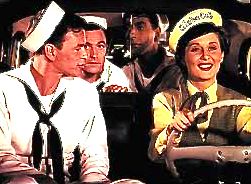
The Skyview NYC Taxicab that the tipster may have seen on TCM was in the musical "Anchors Aweigh". The scene where Frank Sinatra and Gene Kelly are Standing up and looking out at the city in Betty Garrett's Skyview cab. Those DeSoto Skyview Cabs were sold exclusively through James Waters Chrysler Agency in Long Island City, Queens.
The price for a new one was about $1100. I once heard a story that he was Walter Chrysler's Son-in-Law but I can't confirm it.
skyview cab
I believe this is the light-up sign on top of the Sky-View Cab Company. It looks like neon. I was watching an old movie from the forties (?) on TCM and I noticed these cabs. They had a sunroof cut into the roof of the cab so the passengers in the back seat could look up and see the buildings. I can't remember the movie, but the plot involved the passenger looking up and seeing something relevant to the story line. It must have been a gimmick for the cab company. It also must have been one of the early sunroofs in a car!
D-Day
June 6, 1944, I was 16 years old and in Basic Training with the the US Maritime Service at Sheepshead Bay, Brooklyn. Many of us teenagers had close relatives in the military and wished we were there with them to fight the Axis. A month later, I was in a North Atlantic convoy assigned to a 20 mm anti-aircraft gun hoping that a Nazi plane would dare to fly over. "I'd show 'em." Of course I didn't tell this to my shipmates.
Bright Lights, Big Sign
News Zipper
From a 2005 NYT article on the Zipper:
The Motograph News Bulletin, to use its original formal name, began operation on Nov. 6, 1928, election night, as a band of 14,800 light bulbs that extended 380 feet long and 5 feet high around the fourth floor of what was then the Times Tower. It was installed for The New York Times by Frank C. Reilly, according to an article in The Times, which identified Mr. Reilly as the inventor of electric signs with moving letters.
Inside the control room, three cables poured energy into transformers. The hookup to all the bulbs totaled 88,000 soldered connections. Messages from a ticker came to a desk beside a cabinet like the case that contained type used by old-time compositors. The cabinet contained thin slabs called letter elements. An operator composed the message, letter by letter, in a frame.
The frame, when filled with the letters and spaces that spelled out a news item, was inserted in a magazine at one end of a track. A chain conveyor moved the track, and each letter in the frame brushed a number of electrical contacts. Each contact set a light flashing on Broadway.
There were more than 39,000 brushes, which had to undergo maintenance each month. The frame with the letter elements passed up and overhead, forming an endless circuit. Mr. Reilly calculated that there were 261,925,664 flashes an hour.
Radio Coverage
The National Archives in College Park, Maryland has recordings of the entire NBC and CBS broadcast day from D-Day and anyone can go in and listen to them. It's a very good way to get a sense of what the day was like for people at home listening on the radio as events unfolded.
DeSoto Sky View
Those great old DeSoto cabs had a sliding roof panel to let passengers see the views above them while being carried through the Manhattan canyons. The skyscraper with the clock housed the Paramount Theatre, a wonderful place to visit for a movie and a live stage show. I saw Phil Spitalny and his "All-Girl Orchestra featuring Evelyn and her Magic Violin" there with my family. The movie was "Miss Susie Slagle's," starring Veronica Lake and Sonny Tufts.
Walking to church
On January 6, 1944, I was 6 years old in Fort Smith, Arkansas, part of a young generation which at the time had no knowledge of a condition known as peace. On that day, my mother received a phone call from a fellow church member who was calling everyone in the congregation to say that the invasion was under way. This was the signal to come to the church to pray. Our family; mother, father and two boys walked to the church to pray for the safety and success of our "American Boys" on that day.
So what about that moving sign?
According to various sources the NY Times installed the first moving "news ticker" in 1928, using 14,800 electric bulbs. Given the technology of the day, I can only guess that each bulb required a relay, which would have to click on and off almost instantly to momentarily light its bulb, as the text scrolls along. This must have been a maintenance challenge (there seems to be a few extra bulbs lit, and some brighter ones that may just have been replaced). They may have used or even invented the "matrix" technique still used today for LCD displays, which uses "crosspoint" wiring to greatly reduce the number of lines going from the elements to the control system, but my mind still boggles at the number of wires remaining, and what kind of electro-mechanical system translated "operator input" to the streaming text. If only Shorpy's world-wide readership included a retired electro-mechanical sign technician!
Internet, 1944
is what this could have been titled. The scrolling electric sign was as good as it got then, and I am sure those folks were fairly amazed to see it. I wonder what it took to program it?
My great-uncle went in at D Day +60 (August 7) as a replacement in the 2nd Infantry Division (L Company, 23rd Infantry Regiment); he was seriously wounded at Brest, France, a month later, died in 1956...and I was named for him.
That was never far from my mind when I served in Iraq in 2004 at the same age he was when he earned his Purple Heart and (I believe) a Bronze Star.
To all those who went in on D-Day...and throughout WWII, I stand and salute.
Kind of Glad
we can't see many faces in the crowd. We'd have to start wondering what they were thinking -- Is my son there? My dad? My husband? My brother?
Funny but I cannot summon up any memory of D-Day. VE and VJ Days, and the dropping of the two A-bombs are sharp and clear, but not D-Day.
I think perhaps that it might relate to what happened in early May. I was out riding my trike when a Western Union messenger rode up on his bike and went into the three-family apartment in which I lived. I heard a terrible scream through the open windows of the first-floor unit. All the neighbors (women since the men were in the military or working) flocked to the apartment with screams continuing for some time. I learned that the woman's son had been killed in action.
I did not totally understand the horror, but I was sad because the young man had been very nice to the punk kid airplane nut from the third floor, even letting me hold his model planes.
The first-floor family were an elderly couple, with the one child, who had become a fighter pilot in the Pacific. The husband walked with heavy braces and crutches, and, as I later learned, they just quit and gave up life. They moved within days and we never heard from them again.
I think that I was in a bit of a void for a while.
6-6-44
Yet to be born, a twinkle in my father's eye as he dropped from the sky into Caen with the Canadians early that morning. RIP Dad.
23,740 days later
Pausing to remember
My brother landed D-Day plus 12 and my uncle D-Day plus 20. They were lucky, I guess, and returned to us to live out long lives. Great photo. Really profound.
Just the technology of the news line was something...
Before zooming in to see the image full size, on first glance the guy on the left and the guy 2nd from the right were in a posture not to different than someone holding a cellphone to the ear. Of course it's clear they were dragging on fags, sucking on coffin nails, drawing down on Pall Malls while taking in the portentous news. As someone not born until 12 years after the war was over - I am fascinated by what day to day life in the US was like, mobilized for war. Of course I grew up knowing it was a success, but at that very moment, who knew how this was going to work out - the intensity of the moment, even for folks in the street in Times Square, must have been incredible.
Unidentified Object
Does anyone know what the curved metal object with letters on it is? It appears to be on top of a car on the right.
[DeSoto "Sky View" taxicab sign. - Dave]

 Shorpy.com is a vintage photography site featuring thousands of high-definition images. The site is named after Shorpy Higginbotham, a teenage coal miner who lived 100 years ago. Contact us | Privacy policy | Accessibility Statement | Site © 2024 Shorpy Inc.
On Shorpy:
Today’s Top 5