


Framed or unframed, desk size to sofa size, printed by us in Arizona and Alabama since 2007. Explore now.
Shorpy is funded by you. Patreon contributors get an ad-free experience.
Learn more.



- Details, Details
- What's that building to the left of the tower?
- Coal Barges
- Bromo-Seltzer
- Inner harbor
- The Basin
- What a headache!
- Giant stepladder?
- Baldwin 62303
- Baldwin VO-1000
- Cold
- No expense spared
- Tough Guys
- Lost in Toyland
- And without gloves
- If I were a blindfolded time traveler
- Smoke Consumer Also Cooks
- Oh that stove!
- Possibly still there?
- What?!?
- $100 Reward
- Freeze Frame
- Texas Flyer wanted
- Just a Year Too Soon
- WWII -- Replacing men with women at the railroad crossing.
- Yes, Icing
- You kids drive me nuts!
- NOT An Easy Job
- I wonder
- Just add window boxes

Photos submitted by Shorpy members!
Print Emporium

Mammoth Plates: 1891
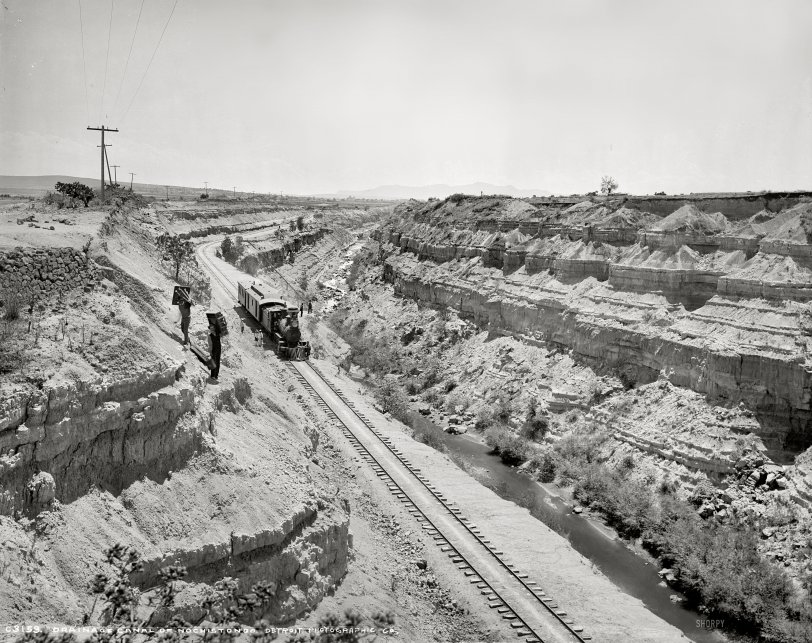
Mexico circa 1891. "Ferrocarill Central Mexicano. Canal of Nochistongo," a drainage excavated in the 17th and 18th centuries to keep Mexico City from flooding. Note the giant camera and tripod employed by William Henry Jackson in the making of his heroically proportioned photographs, the largest of which were recorded on a medium the archivists call "mammoth plates" -- glass negatives that measured 18 by 22 inches. (This particular image was made on an 8x10 inch glass plate -- what modern photographers would consider "large format," but still only a fifth the size of an 18x22.) Detroit Publishing Co. glass negative. View full size.
Nochistongo Cut
The little town in the background distance of the photo is Huehuetoca, State of Mexico. The domed church that you can see in the distance is still there and can be located near the center of town on google maps. This impressive ditch called the Nochistongo Cut (El Tajo de Nochistongo) was dug by hand (mostly indigenous near slaves) starting, if I recall correctly, in about 1607 and took about 120 years to complete. It is said that up to 30,000 laborers were worked to death in the process, though I haven’t seen any historical texts confirming it. Considering the times & place it could easily be true. It’s about 45 miles from Mexico City and is visible (the ditch) in satellite view though the waterway is obscured by trees & bushes. The railroad still passes there but there are 4 lines now. The area is rapidly filling up with outer suburbs of the capital. It was dug in an effort to relieve the severe flooding Mexico City was subject to ever since the Spanish conquest, when the Spaniards as a tactic destroyed some of the protective dikes the Aztecs and their precursors had erected to regulate water flow in the Valley of Mexico and then proceeded to erect their own capital city on the ruins. Ultimately the cut was not successful at stopping the flooding, as Mexico City was sinking slowly into the mud of the ancient lake beds, leaving the drainage collectors too high to drain all of the low areas of the city.

Little Town in the background
I like how you can make out the little town in the background of the photo. You can see the big church with its dome and towers.
Very nice picture. I wonder where in Mexico this was taken.
Glass Plates
Glass plates were coated on the spot. Or at least the night before. The glass was the expensive part, the silver nitrate emulsion came in either screw top tins or light tight jars, and were coated in the field. If the plate negative was not satisfactory it was a simple matter to strip the emulsion, recoat the glass plate and try again.
[You're thinking of the wet-plate negatives used around the time of the Civil War. Most glass plates made after 1880 (including this one) are dry-plate negatives -- coated with emulsion by the manufacturer and presensitized. - Dave]
Rapido corren los carros
Makes me think of a rolling "rrrrrr" tongue-twister a Mexican priest taught me many years ago: "Rapido corren los carros cargados de azucar de los ferrocarriles."
The Big Picture
>> Were those "Mammoth Plate" cameras custom or home made or were they available commercially?
If you were a photographer in the mid 19th century you'd most likely buy a prefab lens assembly and make the box yourself (not that complicated, as most cameras then didn't have shutters), or have one made to your specification. After the Civil War, American Optical, Scovill and the Henry Clay Co. were among the commercial makers of big view and box cameras. A nice selection here.
Perspective
Is anyone fooled by the perspective here? It doesn't look like that ledge is tall enough for the train to look as tiny as it does!
Unsteady footing
One slip, and goodbye large format camera, tripod and photographer!
Impressive
I used to shoot a lot of landscapes in large format (4x5) before the digital age hit photography. I can identify with these gents lugging all that equipment around but not to the extent they did. I cannot imagine 18x22 in the field. My hat's off to them. That's an extremely hard thing to do.
Big Cameras
Were those "Mammoth Plate" cameras custom or home made or were they available commercially?
 Shorpy.com is a vintage photography site featuring thousands of high-definition images. The site is named after Shorpy Higginbotham, a teenage coal miner who lived 100 years ago. Contact us | Privacy policy | Accessibility Statement | Site © 2024 Shorpy Inc.
On Shorpy:
Today’s Top 5