



Framed or unframed, desk size to sofa size, printed by us in Arizona and Alabama since 2007. Explore now.
Shorpy is funded by you. Patreon contributors get an ad-free experience.
Learn more.



- Details, Details
- What's that building to the left of the tower?
- Coal Barges
- Bromo-Seltzer
- Inner harbor
- The Basin
- What a headache!
- Giant stepladder?
- Baldwin 62303
- Baldwin VO-1000
- Cold
- No expense spared
- Tough Guys
- Lost in Toyland
- And without gloves
- If I were a blindfolded time traveler
- Smoke Consumer Also Cooks
- Oh that stove!
- Possibly still there?
- What?!?
- $100 Reward
- Freeze Frame
- Texas Flyer wanted
- Just a Year Too Soon
- WWII -- Replacing men with women at the railroad crossing.
- Yes, Icing
- You kids drive me nuts!
- NOT An Easy Job
- I wonder
- Just add window boxes

Photos submitted by Shorpy members!
Print Emporium






Christmas: 1956
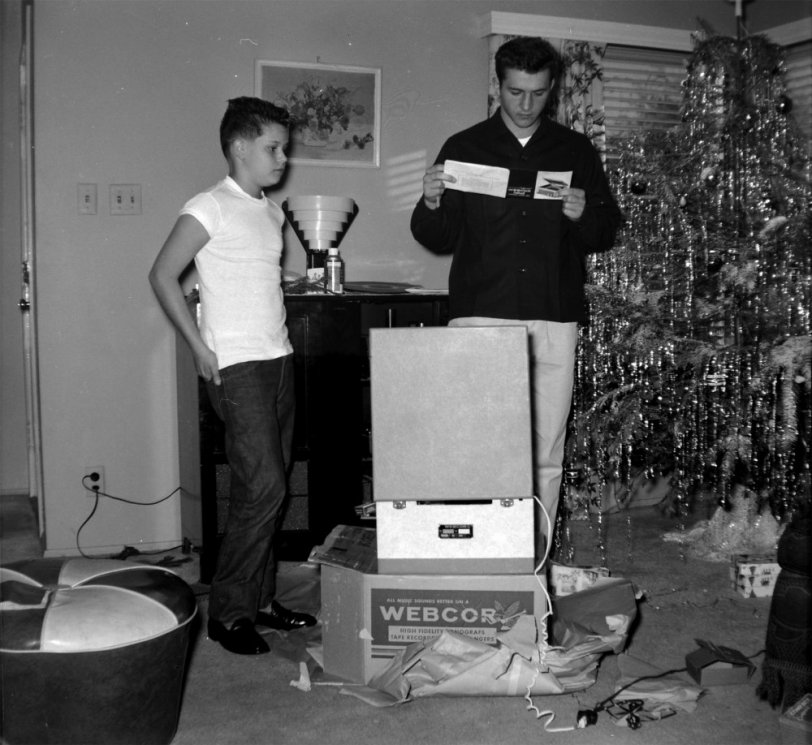
This was taken in Los Angeles, 1956. The present just opened is a Webcor record player. To the left is my great uncle Paul and the right is my grandpa, seen later washing the car with my dad.
I wonder if there's a tree under all that tinsel. Scanned from a Kodak safety negative. View full size.
Awesome
Tony you and tterrace may need to start your own site or have Dave hire you both as permanent contributors (pay you with real money) I do love ALL the member contributions, but the ones you both have, something special about them.

Webster Chicago
Webster-Chicago Corp. was the parent company of Webcor, a leading manufacturer of Wire & Tape Recorders. They pioneered the wire recorder in the 1950s. Those units fed a spool of wire, that was on a reel resembling tightly wound fishing line, through a recording head of the player/recorder. The wire was not unlike piano wire, the recorded sound was fairly primitive and we sold the recorders in the $300-500 range, not a small sum in the 1950s. Once the reel-to-reel tape recorders came in the wire products were doomed. Of course the cassette tape did in the reel-to-reel, the CD did it to the cassette. Now they're all dead or dying. The top recording device makers of the wire era were Webcor, VM (Voice of Music), Wilcox-Gay and the ubiquitous General Electric.
Webcor phono
It was a slightly earlier Webcor portable phonograph that transitioned our family from the 78rpm era to the LP (in today's terms, think of going from VHS to DVD). That was a bit before 1950 when we won it in a church raffle. Later, it became the centerpiece of my brother's hi-fi system: it's at the bottom of the stack behind the tubed amplifier in this shot. The Devo-style lamp is an eye-catcher, but so is the ottoman in the lower left, looking like an orphan from a Rat-Pack era Las Vegas lounge.
Pure 50s
Wow, Tony. The family photos you've posted really evoke their time and place very clearly. I hope your grandfather and great uncle won't take offense when I observe that in this shot they look a lot like the Beav and his brother Wally (Jerry Mathers and Tony Dow), in the show that had its first season the following year.

Previewing the future
A little early for Devo on the phono, but the hat is already there...
 Shorpy.com is a vintage photography site featuring thousands of high-definition images. The site is named after Shorpy Higginbotham, a teenage coal miner who lived 100 years ago. Contact us | Privacy policy | Accessibility Statement | Site © 2024 Shorpy Inc.
On Shorpy:
Today’s Top 5