


Framed or unframed, desk size to sofa size, printed by us in Arizona and Alabama since 2007. Explore now.
Shorpy is funded by you. Patreon contributors get an ad-free experience.
Learn more.



- Not just S&P
- re: Those things in the jar
- Up In Smoke
- Medical Smoking
- Quick fix
- A Quink Comment
- If You’re Like Me, Never
- Delivering the News
- U.S.A.
- S&P
- 1940 Zenith radio model 6G601
- Quality goes in before the name goes on!
- Snazzy skirt
- Carbon Arc Lamps
- Illuminate us
- I remember it well
- I can't prove it
- Complicated then, forgotten now
- Bryan-Stevenson
- Skinny is as skinny does
- How do you rest in peace
- Riding the footboards
- Alas, hidden from view
- Baldwin Diesels
- Exclusive pump
- Bananas, Oysters and Smokey Joe
- Details, Details
- What's that building to the left of the tower?
- Coal Barges
- Bromo-Seltzer
Photos submitted by Shorpy members!
Print Emporium
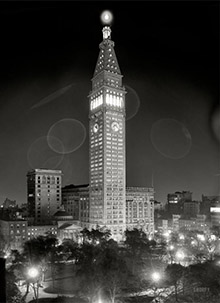


Water Street, Night: 1943
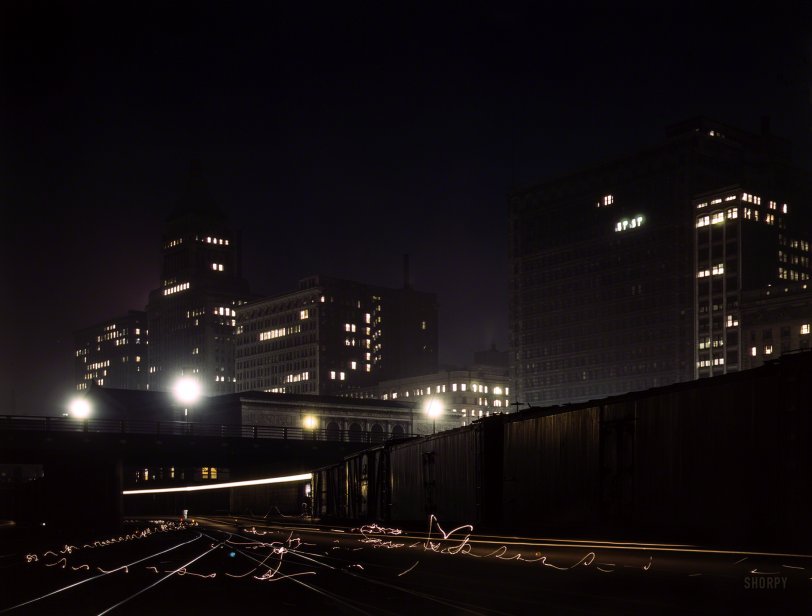
May 1943. "South Water Street freight terminal of the Illinois Central R.R., Chicago." 4x5 Kodachrome transparency by Jack Delano. View full size.
Today's view looking south from Monroe Street
The bridge over the tracks in the 1943 photo is Monroe Street.
The low classical building is the Art Institute, and today you see its hall built over the tracks, leading to its later wings to the east. The building with the pyramidal top is the Metropolitan Tower.
The train tracks are still here and well-traveled, carrying Metra commuter trains to Randolph Street station under Millenium Park.

Autographed
Love these time exposures. Here, we find a lonely track worker, with a lantern in hand, signing his name to the photograph.
Blackout regulations
Blackouts were observed during blackout alerts. In coastal regions blackouts were on the shore side. From an April 1943 newspaper clipping:
Blackout regulations are now uniform in a large area from the Atlantic Coast to the Mississippi River.
Revised Signals.
The new blackout signals differ from signals used in the past in that a second audible "blue" signal is used. The blackout signals now in effect follow:
First or blue signal. This will be the first signal the public will hear. It will be a long blast of two minutes duration. When this is sounded all lights except the street lights and those in essential war industries must be extinguished. Traffic will continue to move with dimmed lights and pedestrians will move to place of shelter.
The second or red signal will be a series of short blasts extending over two minutes. With this all traffic ceases except those vehicles with proper identification which have been given permission to move. War industries drop their blackout shades. Passengers have to leave cars and busses for shelter Third Audible Signal.
The third audible signal will be a second blue signal. This will be a long blast of two minutes duration. Street lights will go on. War Industries remove their blackout shades. All other lights will remain extinguished. Vehicular traffic will resume "on the low beam."
The next signal will be the all clear, which will be one short blast of 15 seconds duration. The all clear will be announced over the radio.
Why no blackout in effect?
I'm wondering why blackout regulations weren't seemingly in effect this night while the war raged in 1943. I know the coast was under blackout regulations but I also thought that the Great Lake coasts were too because of the possibility of enemy submarines heading up the St. Lawrence River.
Just a thought!
 Shorpy.com is a vintage photography site featuring thousands of high-definition images. The site is named after Shorpy Higginbotham, a teenage coal miner who lived 100 years ago. Contact us | Privacy policy | Accessibility Statement | Site © 2024 Shorpy Inc.
On Shorpy:
Today’s Top 5