


Framed or unframed, desk size to sofa size, printed by us in Arizona and Alabama since 2007. Explore now.
Shorpy is funded by you. Patreon contributors get an ad-free experience.
Learn more.



- What a headache!
- Baldwin 62303
- Baldwin VO-1000
- Cold
- No expense spared
- Tough Guys
- Lost in Toyland
- And without gloves
- If I were a blindfolded time traveler
- Smoke Consumer Also Cooks
- Oh that stove!
- Possibly still there?
- What?!?
- $100 Reward
- Freeze Frame
- Texas Flyer wanted
- Just a Year Too Soon
- WWII -- Replacing men with women at the railroad crossing.
- Yes, Icing
- You kids drive me nuts!
- NOT An Easy Job
- I wonder
- Just add window boxes
- Icing Platform?
- Indiana Harbor Belt abides
- Freezing haze
- Corrections (for those who care)
- C&NW at Nelson
- Fallen Flags
- A dangerous job made worse

Photos submitted by Shorpy members!
Print Emporium
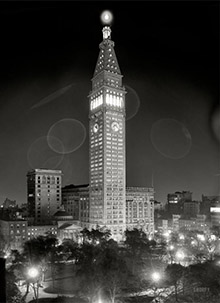
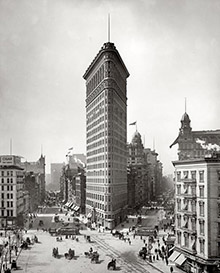
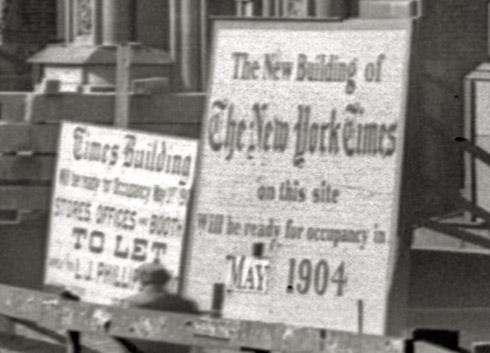
Ready for Occupancy May 1904
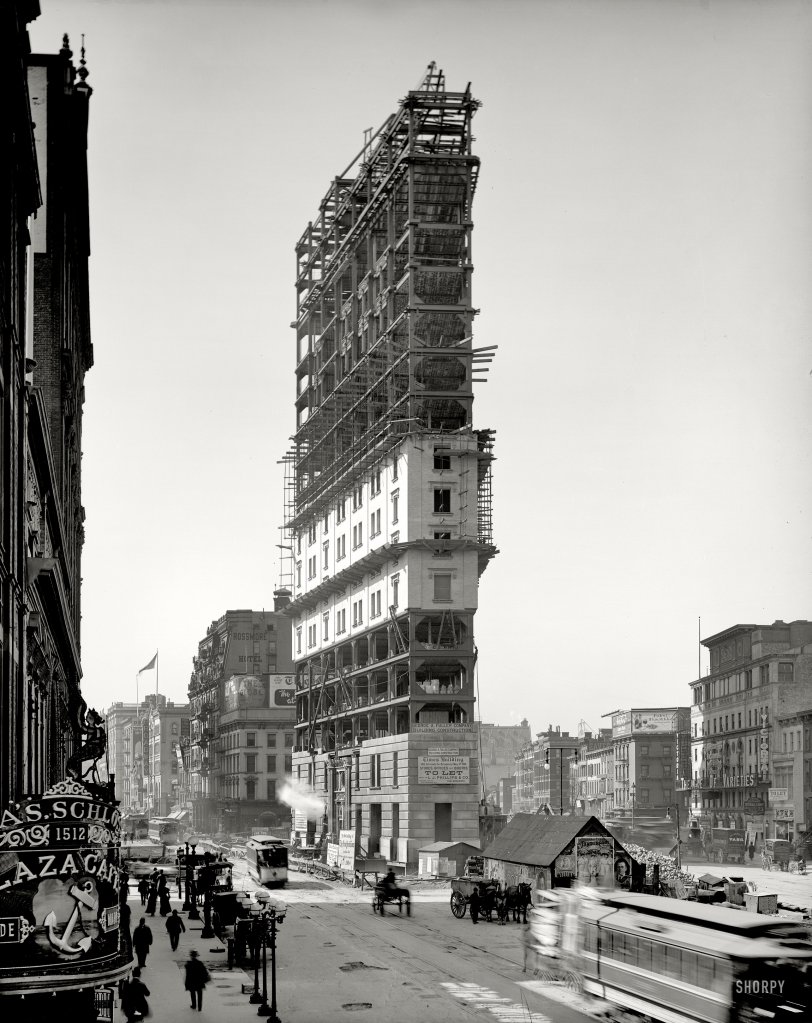
New York circa 1903. "New York Times building under construction." 8x10 inch dry plate glass negative, Detroit Publishing Company. View full size.
Quick question
Is this view looking south or looking north?
[South. -tterrace]

Floor arches
Answer to a two year old question: they used hollow tile terra cotta floor arches then poured concrete over top.
William Collier
AKA Willie Collier - Looking at the posters closely you can barely make out "Charles Frohman Presents" on the Collier poster to the left of the playbill posted for "The Tenderfoot." Which makes this play THE DICTATOR which, according to IBDB.com opened at the Criterion Theater on April 4, 1904 (barely legible on the left hand posters) and closed May 30, 1904. Looking down the street you can see that THE TWO ORPHANS was playing at the New Amsterdam Theater - Mar 28, 1904 - May 1904. Richard Carle's THE TENDERFOOT was at the New York Theater Feb 22, 1904 - Apr 30, 1904. Which I think may place this photo solidly in 1904 because these don't look to be coming attractions? Interesting that the building is scheduled for occupancy in May of 1904.
As a sidebar - one of Willie's young co-stars in THE DICTATOR was John Barrymore who in 1904 would have been a callow 22 years old. According to "The Film Acting of John Barrymore" By Joseph W. Garton, Collier was an intimate family friend of Barrymore's father Maurice and was to be Barrymore's informal theatrical mentor for several years starting in 1903.
Two years later, on April 18, 1906, Mr. Barrymore in San Francisco on tour with THE DICTATOR would be thrown from his bed into the bathtub by another event frequently chronicled by Shorpy. One amusing account has him doing his bit by serving cognac to his fellow survivors in front of the St. Francis Hotel.
In 1915, a 30-something Barrymore starred in the title role of THE DICTATOR in the silent film version produced by Frohman and Adolph Zukor of the Famous Players Film Company.
No need for Photoshoppe
That small sign appears to have the same text as the lowest sign on the end of the building.
With the help of photoshop
I was able to distort these two signs. The big sign says "the new building of the new york times in this site will be made for occupancy in ___ 1904".
can anyone make sans of what the small sign says?
[The title of this blog post, above the photo, might fill in one of those blanks. - Dave]
More details
I love the four tilting windows over the entrance of that building just up from the Theatre of the Varieties.
I wonder if the William Collier on the posters lining the side of the Tenderfoot building is this guy.
I think that building is what eventually became the Times Square Army recruitment site.
Funny to see Times Square looking so simple and small town. Given the theme park it's turned into, I kind of prefer this one.
Theatre of Varieties
Here's a link to the history of Oscar Hammerstein's Victoria Theatre, visible on the far right ("Theatre of Varieties"). Built in 1899, gone by 1916 or so. Houdini, Irving Berlin and Will Rogers performed there.
The forum comments are interesting for any NY theatre buff.
Floored
Can anyone tell me how the floors were constructed in buildings of this era? It looks like there are wooden planks laid down over the steel floor support members. Was concrete then poured over this sub-flooring?
Fuller Construction Co.
The same outfit that built the Times Building also built the Flatiron building. I know one poster here had mistaken this building for the Flatiron (on 23rd Street). George A. Fuller is the man considered the father of the modern skyscraper, and in fact the Flatiron Building was originally named the Fuller Building.
Second tallest, but not for lack of trying
The owners of the Times Tower (362 feet high) sought to gain an edge over the reigning record holder, the Park Row Building (391 feet), by two methods: 1) Measuring from the lowest subbasement to the top of the flagpole (476 feet); 2) Because Times Square is at a higher elevation than downtown Manhattan, the Times Tower "scraped higher clouds" than its downtown competitor. I guess that's all the news that's fit to print.
Logistics
Wonderful photo!
I wonder what kind of vehicles were used for delivery of steel beams for the construction back then? And looks like there was no enough space to store them, so apparently builders had to lift them up right from the vehicle.
Times Building / Allied Chemical
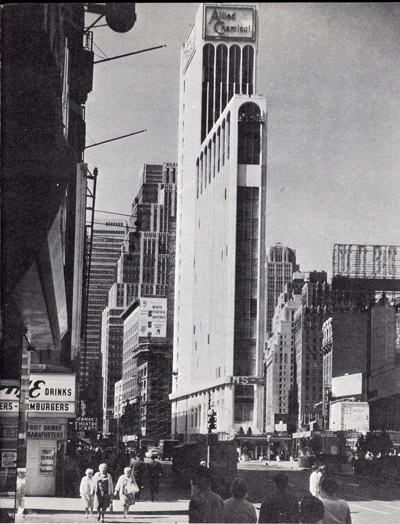
The Allied Chemical Building on One Times Square inaugurated in 1965 after "modernisation" of the old 1904-05 Times Tower. A rare picture without any billboards on the building.
(Thanks to Wired New York)
The Tenderfoot
Richard Carle's musical play "The Tenderfoot" (poster partially obscured by the streetcar) opened in Chicago in 1903, and was also made into a movie with Joe E. Brown and Ginger Rogers in 1932.
Underground Paper
Architecturally, the NYT tower was a mixed bag ("inspired by the Campanile of Giotto at Florence"). It was more interesting structurally. The basement excavation went 60 feet below curb level, with 2,500 tons of presses in the sub-subbasement, whose floor area was three times that of the street-level footprint -- the underground levels ballooned out past the boundaries of the tower the farther down you went. I wonder what all that subterranean space is used for now.
PBR in 1903!
Did not know there was Pabst Blue Ribbon back that far. Very cool.
A famous unknown
This has been described it as the most famous building in America whose architecture is completely unknown. It was apparently the second tallest building in the world when it was constructed.
It was gutted and stripped in the 1960s, losing all ornamentation and most tenants above the first floor due to the high costs costs associated with installing a central air-conditioning system, and was restyled as a boring concrete and marble structure with few windows.
Today it's a giant billboard, but makes more money than if it were fully rented. It can be glimpsed in the film Taxi Driver, when only the Zipper was on the building.
[One side note -- when it opened, 1 Times Square was the second tallest building in Manhattan (after the Park Row building), not the world. There are many cathedrals, hundreds of years old, taller than 375 feet. - Dave]
Half-Off
Is that the granddaddy half-price theater ticket kiosk?
Gone to Pot!
Look at all the potholes!, and, I thought they were a more-modern phenomenon brought on by the horseless carriage.
Thank You again for another great photo from long ago.
Solves a puzzle
I have always been curious as to what that building really looked like without all of the electric signs and billboards globbed around it. Though I have been there a few times, didn't realize the building was that narrow.
 Shorpy.com is a vintage photography site featuring thousands of high-definition images. The site is named after Shorpy Higginbotham, a teenage coal miner who lived 100 years ago. Contact us | Privacy policy | Accessibility Statement | Site © 2024 Shorpy Inc.
On Shorpy:
Today’s Top 5