



Framed or unframed, desk size to sofa size, printed by us in Arizona and Alabama since 2007. Explore now.
Shorpy is funded by you. Patreon contributors get an ad-free experience.
Learn more.



- Famous Hollywood faces
- Not just S&P
- re: Those things in the jar
- Up In Smoke
- Medical Smoking
- Quick fix
- A Quink Comment
- If You’re Like Me, Never
- Delivering the News
- U.S.A.
- S&P
- 1940 Zenith radio model 6G601
- Quality goes in before the name goes on!
- Snazzy skirt
- Carbon Arc Lamps
- Illuminate us
- I remember it well
- I can't prove it
- Complicated then, forgotten now
- Bryan-Stevenson
- Skinny is as skinny does
- How do you rest in peace
- Riding the footboards
- Alas, hidden from view
- Baldwin Diesels
- Exclusive pump
- Bananas, Oysters and Smokey Joe
- Details, Details
- What's that building to the left of the tower?
- Coal Barges

Photos submitted by Shorpy members!
Print Emporium






Midwest Utilitor: 1920
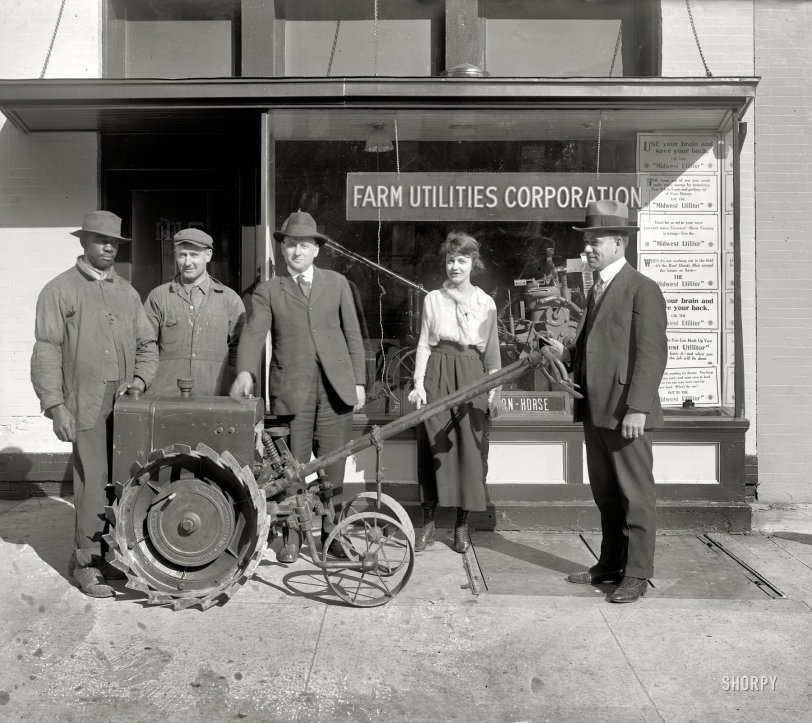
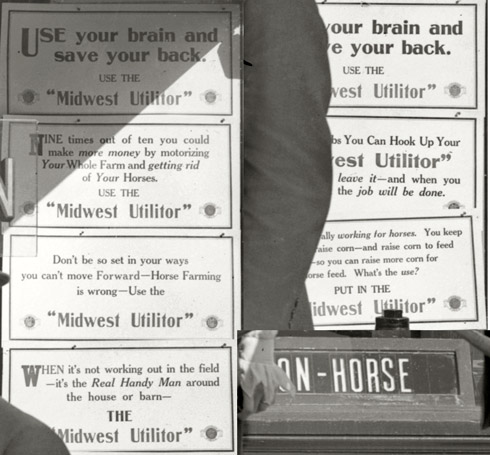
Washington, D.C., circa 1920. "Farm Utilities Corp. (exterior), 14th Street N.W." The two three draws here, for me at least, are the amused expressions of all concerned, and the name of this particular piece of equipment: "Midwest Utilitor." Oh, and the entertaining signage in the window. National Photo. View full size.
Located
The location of the photograph is 1115 14th Street NW. Ads show that Farm Utilities also sold the Merry Garden auto-cultivator. Any trace of the company seems to have disappeared by 1923. The Utilitor was manufactured by the Midwest Engine Company of Indianapolis.
The photo shown here was printed in the Washington Herald on March 21, 1920 on Page 3 with the following caption.
"Showing a part of the personnel of the Farm Utilities Corporation used exclusively for the distribution and sale of the Midwest Utilitor, 1115 Fourteenth street, recently purchased by them, and is being remodeled for their special requirements. The building will house the showroom, general offices, service school, stock room, and repair and supply department.
"The show window display of this week is attracting much attention and interest as it contains a section sawed-out view of the Utilitor showing its inside mechanism.
"A. Wade Wells has arranged, weather permitting, to give a street demonstration during Motor Car Week."
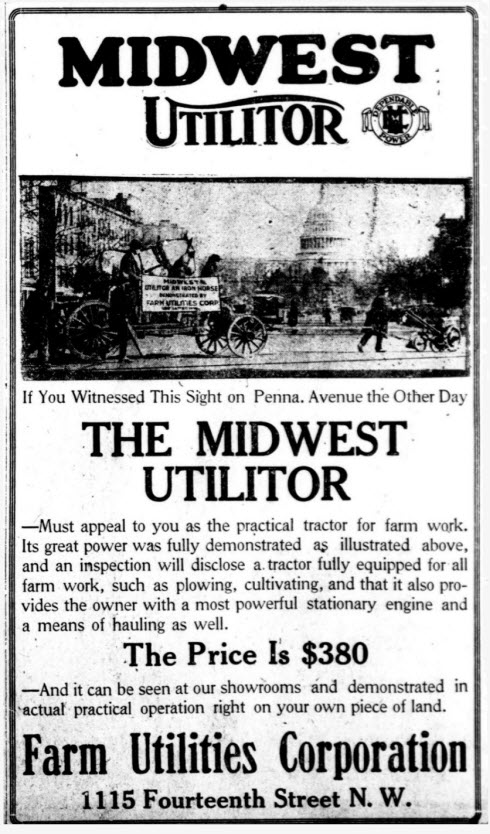
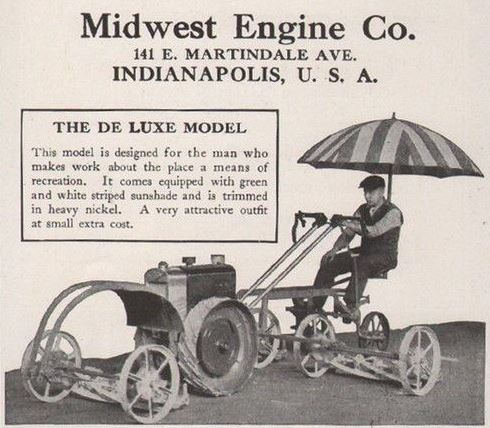
The advertisement below is from February 22, 1920 in the Washington Herald, and the deluxe version ad is from an unknown original source. The July 1989 issue (Volume 24, Number 7) of Gas Engine Magazine has a five page feature on the machine.

Comic book hero
I am the Mighty Utilitor: bow down before me! Or I can till your garden. Your call.
Neat Chick
No raving beauty, but she seems to exude personality.
Stelzer & Co.
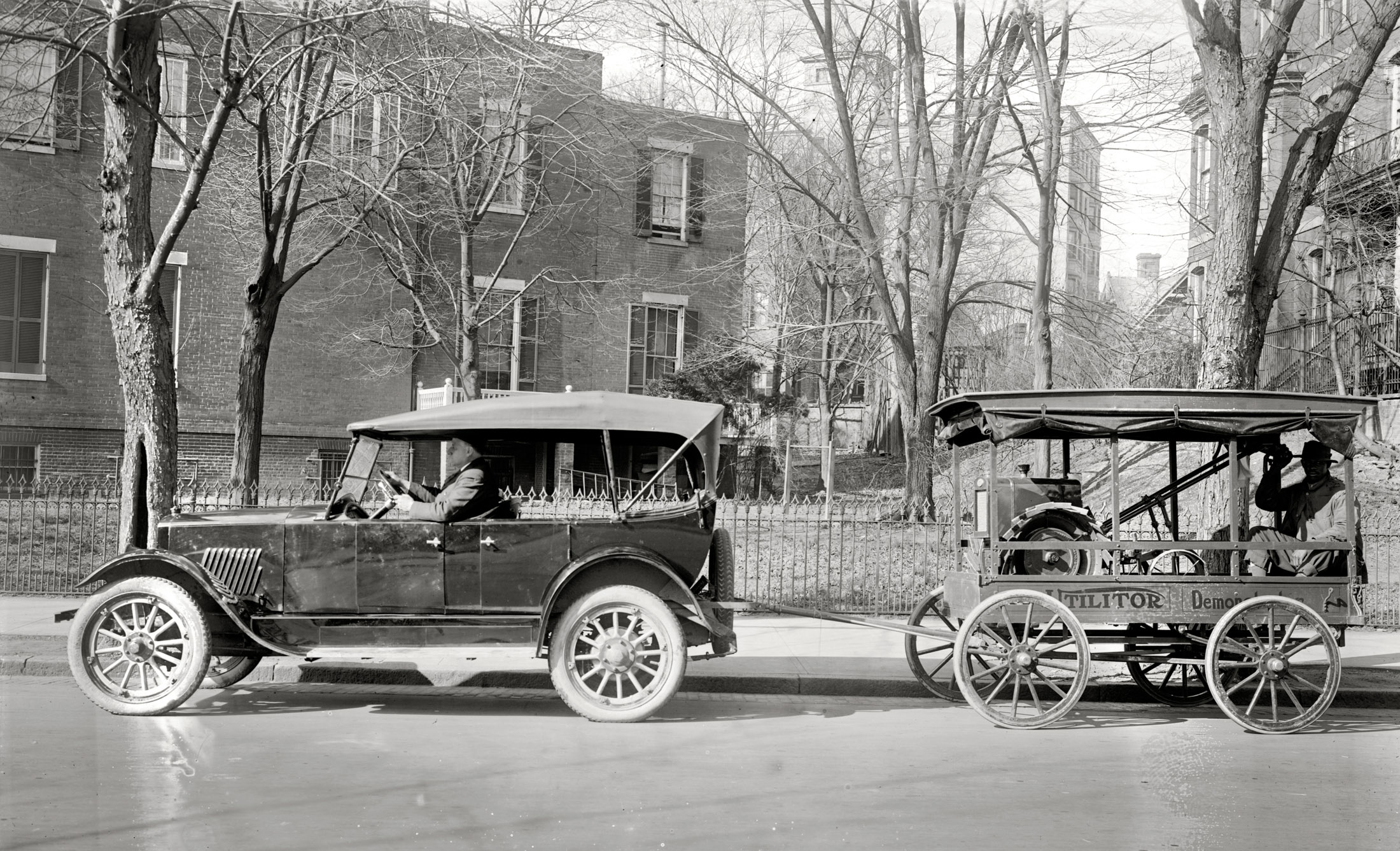
The text from the following ad accompanied a different photograph, possibly taken the same day. I suspect one of the men in suits is Frederick C. Stelzer. Prior to dealing in Utilitors, Stelzer & Co., 1115 14 St. N.W., sold plumbing and heating fixtures. [Update: Thanks to Dave for including the appropriate high-resolution image below. Click on it to embiggen.]
Washington Post, Apr 4, 1920A Practical Demonstration
The above snapshot was taken of Mr. Fred Stelzer leaving Washington to give demonstration of the Midwest Utilitor. Was he going to your farm? If not, why not?
It plows, harrows, cultivates, hauls a cart and is a 4-horsepower portable engine which can be used for various kinds of beltwork. Write or call for demonstration on your own piece of land.
Some valuable territory open to dealers, also good opportunity for live-wire salesmen.
Farm Utilities Corporation
1115 14th St. N.W., Washington D.C.
My Guess
From right to left: The guy who sold it, his wife-n-secretary, the guy who bought it, the mechanic, and the guy who actually has to go out and run the thing.
Two observations
First: the flywheel of that thing is set inside the drive wheel, which in my eyes is a rather unusual solution. Second: those two guys behind the Utilitor look like brothers. Nothing unusual about that.
A mystery solved!
The video solves a mystery for us. Crop circles are simply what happens when farmers forget to switch off their Midwest Utilitors before going to bed.
Utilitors from Outer Space
OK, I found myself watching that video about 5 times in a row, and have arrived at the following conclusions: 1. That thing is alive; 2. I'll be having very strange dreams tonight.
YouTube Utilitor
In British Racing Green, yet.
[Another benefit: Free fertilizer. Guaranteed to scare the crap out of any horse! - Dave]
If
Her name is Kay, I think we're onto something!
Handy Power
Actually these kinds of "walk-behind" tractors also were used as a power source to run all kinds of equipment like washing machines, generators, milking machines, etc. Much more than you can do with a horse!
The housewife's dream
I'd like to see it handling some of those tiresome everyday chores around the house. Can it core a apple?
Two questions
How many mules did this device replace? When horses and donkeys were bred to get a mule, was the horse always the mother? My vote is for the horse to be the mother.
Utilitor
Anagram: I roil Tut. Specialized archaeological device for testing the validity of the curse on despoiling ancient Egyptian tombs.
"Horse Farming is wrong"
So don't be set in your ways! You can hook up your Midwest Utilitor, leave it, and when you get back, the job will be done! I need me one of those.
 Shorpy.com is a vintage photography site featuring thousands of high-definition images. The site is named after Shorpy Higginbotham, a teenage coal miner who lived 100 years ago. Contact us | Privacy policy | Accessibility Statement | Site © 2024 Shorpy Inc.

On Shorpy:
Today’s Top 5