



Framed or unframed, desk size to sofa size, printed by us in Arizona and Alabama since 2007. Explore now.
Shorpy is funded by you. Patreon contributors get an ad-free experience.
Learn more.




- Baldwin 62303
- Baldwin VO-1000
- Cold
- No expense spared
- Tough Guys
- Lost in Toyland
- And without gloves
- If I were a blindfolded time traveler
- Smoke Consumer Also Cooks
- Oh that stove!
- Possibly still there?
- What?!?
- $100 Reward
- Freeze Frame
- Texas Flyer wanted
- Just a Year Too Soon
- WWII -- Replacing men with women at the railroad crossing.
- Yes, Icing
- You kids drive me nuts!
- NOT An Easy Job
- I wonder
- Just add window boxes
- Icing Platform?
- Indiana Harbor Belt abides
- Freezing haze
- Corrections (for those who care)
- C&NW at Nelson
- Fallen Flags
- A dangerous job made worse
- Water Stop

Photos submitted by Shorpy members!
Print Emporium











33 Center Street: 1910
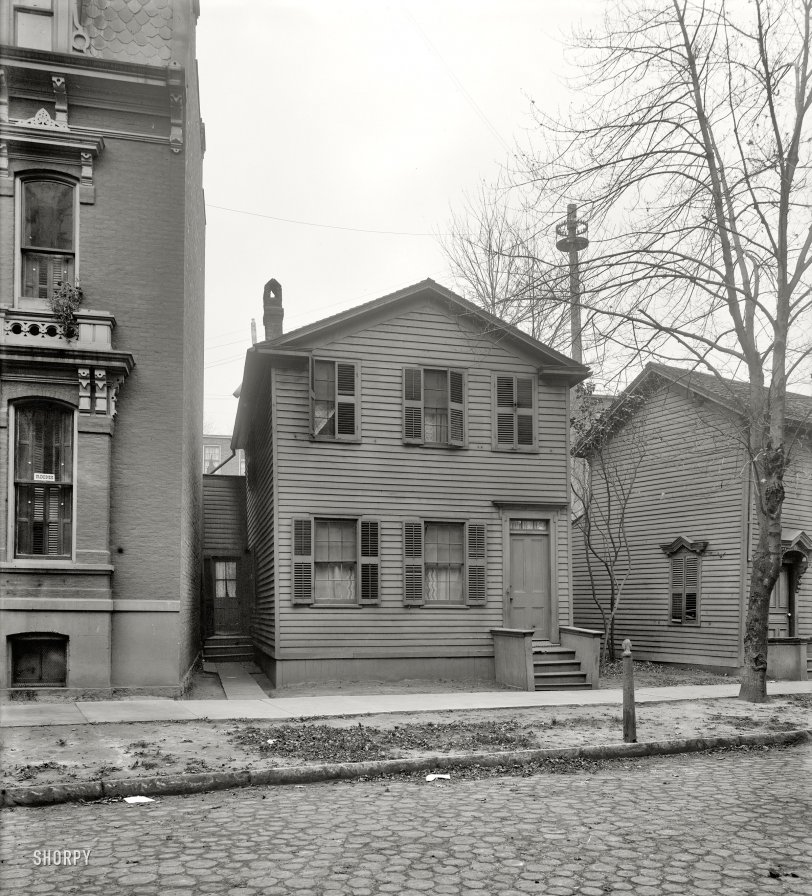
Detroit, Michigan, circa 1910. "No. 33 Center Street." Why this little house is in the Detroit Publishing archive is a mystery to me. Note yet another of those maypole-style telephone line drops. 8x10 glass negative. View full size.
Re: I want my Maypole!
Actually telephone lines are symmetrical, so they always are a pair of conductors.
[A lot of early systems used a single conductor with ground return. - Dave]

Window treatment
I like the way that the pediment over the window of the house next door matches the one over the door. Obviously the houses have come down in the world.
The pavers
Look to be wood, probably soaked in creosote.
Amazing, I'm there
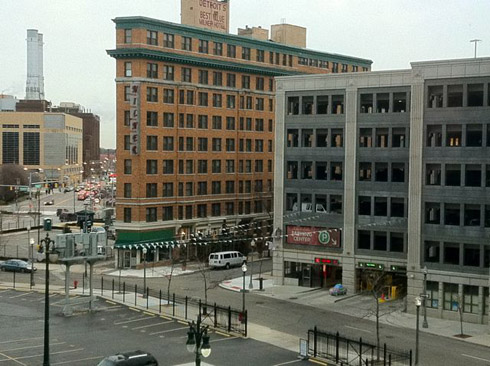
I can actually see the Milner and Center street from my window at work right now. No sign of this house.
Thanks for the time-travel-moment, Shorpy.
Damn Shutters
I can hear them banging all night long!
[Try leaving Mr. Shutter a note. - Dave]
One more detail
And a tip of the Hatlo Hat to the Old Hitching Post.
I want my Maypole!
That's a telephone drop. Single-wire conductors with a ground return. Power lines would be two conductors widely separated.
Curiosity
Just curious if the pole is actually an electric power drop.The insulators appear to be quite large. This area is in the general area where Edison Electric Illuminating was supplying DC power in the very early part of the 1900's.
Photoworthy
Maybe the entry to No. 33 is at the end of that narrow passageway and that is unusual enough to be both noteworthy and photoworthy.
Central Annex
The Milner Hotel now occupies the spot where this building once stood. According to the 1910 Polk City Directory, the building at the right, 31 Center Street, was occupied by one Henry M. Catton. The building at the left was the Central Apartments at 35-41. 33 Center was the "Central Annex" and you can see that there is a connection between the Annex and the larger Central Apartments. Perhaps one of the residents of the Annex gained notoriety, prompting the photograph of their residence?
[My guess would be that whatever historical significance this place has lies back in the 19th century. A Google Books search shows that 33 Centre Street was headquarters of the Detroit Woman's Christian Association in 1890. There may have been some connection with the temperance movement. - Dave]
 Shorpy.com is a vintage photography site featuring thousands of high-definition images. The site is named after Shorpy Higginbotham, a teenage coal miner who lived 100 years ago. Contact us | Privacy policy | Accessibility Statement | Site © 2024 Shorpy Inc.

On Shorpy:
Today’s Top 5