



Framed or unframed, desk size to sofa size, printed by us in Arizona and Alabama since 2007. Explore now.
Shorpy is funded by you. Patreon contributors get an ad-free experience.
Learn more.




- Details, Details
- What's that building to the left of the tower?
- Coal Barges
- Bromo-Seltzer
- Inner harbor
- The Basin
- What a headache!
- Giant stepladder?
- Baldwin 62303
- Baldwin VO-1000
- Cold
- No expense spared
- Tough Guys
- Lost in Toyland
- And without gloves
- If I were a blindfolded time traveler
- Smoke Consumer Also Cooks
- Oh that stove!
- Possibly still there?
- What?!?
- $100 Reward
- Freeze Frame
- Texas Flyer wanted
- Just a Year Too Soon
- WWII -- Replacing men with women at the railroad crossing.
- Yes, Icing
- You kids drive me nuts!
- NOT An Easy Job
- I wonder
- Just add window boxes

Photos submitted by Shorpy members!
Print Emporium




Mother's Little Helper: 1942
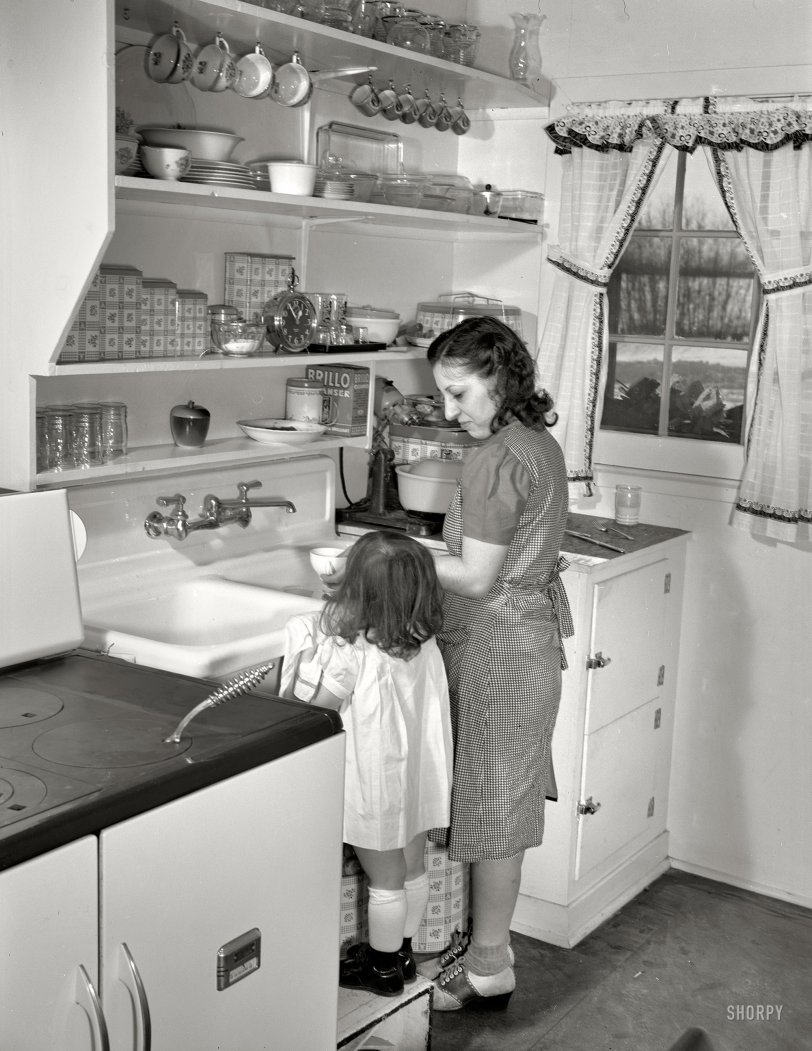
January 1942. "Bantam, Connecticut. Defense homes. Little Ann Heath is eager to try out all the facilities of her parents' new four-room defense housing unit, after spending most of her life in a single furnished room. Here she pushes her footstool to the sink in order to help her mother clean up the dinner dishes. Mrs. Heath, a native of Winsted, a city some 25 miles away, is delighted with her new kitchen -- the first she's ever had which she actually considers as a kitchen, and is trying out all the recipes she has collected in five years of married life. The Heaths pay $30 monthly for their apartment." Medium format nitrate negative by Howard Hollem for the Office of War Information. View full size.
Mystery Solved?
(Originally posted 5-13-2015 - corrected spelling on date shown above) The National plunge into the defense industries did not wait until after the "Day of Infamy" on December 7th, 1941. We had been involved in defense production since 1940, with Lend Lease, and with other reasons to be tooling up for war. The industry's rapid expansion created a rapidly expanding need for housing all the workers that these industries would require to run their facilities for the extended period of time required to keep up production.
Providing decent housing was essential to alleviate the extreme shortage of housing created by the enticement of good wages these jobs offered. Before the production of housing ever caught up with the need, people were tolerating living in extremely challenging, unsanitary circumstances, in tent camps, roadside shacks, trailer camps, in their cars, in overpriced, underserved, ancient apartments and shared rooms with Victorian era plumbing and kitchen facilities, and any other way they could find to get themselves out of the financial grind the Great Depression had trapped them in for so long.
The government housing promised was mostly plain barracks like apartments, with little in the way of ammenities, but the apartment that the Heath family shared was obviously many times more pleasant and livable than the single furnished room they started married life in, likely with the shared bath down the hall. All these apartments were billed as "rooms plus" meaning in this case, four rooms plus the bathroom, as bathroom was never counted in amongst the "rooms" of the house. And all bathrooms were complete, with all three usual fixtures, of tub, sink (or lavatory, in the parlance of the day), with a mirrored medicine cabinet of some type, and toilet (or 'closet,' likewise.) Heat, as seen in another photo linked in another comment, was provided by the combination coal range, heating stove and water heater in the kitchen. There was usually some sort of attached water tank that kept a supply of hot water ready for use. The small size of the apartment, with two small bedrooms, the living room and eat in kitchen made that sort of heating arrangement adequate.
I have a considerable collection of American Builder magazines from the early 40's, which contain a great deal of information about the housing industry as it existed during this time, and it's amazing to read about the builders, the developments, and especially the cost and regulations involved in establishing defense housing during this time. FHA regulations under Title VI limited the cost of defense housing after a period in 1942 to $6000, with a 10% downpayment, leaving the balance to mortgage at $5400 over a period of up to about 20 years. Mortgage payments, or "carrying charges" as they were called, ran in the high $20 to mid $30 range per month, including interest, principle, insurance for fire, and in some areas tornado or "wind damage" and local taxes. Can't imagine paying $35 a month for a house! This of course doesn't include utilities, or maintenance, but most utilities were relatively cheap, and the newest focus on adequate insulation of homes brought heating costs down to a minimum each heating season. Since these houses were brand new, maintenance costs were pretty much non-existent.

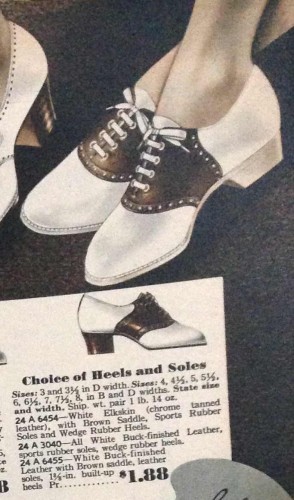
High heeled saddle shoes
This from a 1937 catalog offering the popular styles of the day, including women's saddle oxfords with the high heels, such as Mrs. Heath is shown wearing.
The family in the new living room
..can be found right here, enjoying their overstuffed chairs.
Housewife propaganda
To answer an earlier poster's question about why the OWI was taking photos like this so soon after the US entered the war, I imagine photos like this (and their accompanying captions) were very deliberately intended to appeal to women like Mrs. Heath who were used to living in those one-room apartments. See what you can get if your husband works for the war effort?
In other news, I had never seen high-heeled saddle shoes before - love them.
See Fred Heath fueling the stove/heater
Shorpy picture: https://www.shorpy.com/node/2297
The caption has a few additional bits of information.
E_R
I want the kitchen, and the shoes
Mrs. Heath's kitchen gear is highly desirable right now, but, sadly, her saddle shoes aren't. And that's a shame, because I love saddle shoes and I'd wear 'em with skirts and socks if I could.
Cupboard
Today we just call these shelves but it is infact where the term cupboard came from and it was two words "Cup and board" meaning a simple board on a wall for the purpose of placing cups or other dishes on. People today often refer to cabinets as cupboards but they are in fact not cupboards at all.
Likely Mystery Explanation
From the very beginning of WW2, all Americans were expected to assist our nation facilitate the production of goods and services necessary for winning the war. Aircraft, shipbuilding and munitions factories were pushed into round-the-clock shifts of production requiring thousands of workers, all of whom required adequate housing. Here in San Diego, large old homes in neighborhoods including North Park, Hillcrest and Golden Hill were subdivided into multiple units for the huge influx of this new military and war production labor force. Local housing projects (for example the community of Linda Vista) rapidly appeared where only indigenous wildlife had lived months before. Affordable housing units were a timely necessity, and often newly constructed ones even as basic as Mrs. Heath's were a genuine improvement over those many had occupied shortly before.
Fitzgerald Magic Maid
The mixer appears to be a Fitzgerald Magic Maid from the 1920s or '30s. Probably a lovely Jadite Green color with bowls to match, a popular color in that era, as well as now among collectors.
Dime-Store Demographic
I'll second everything OTY has written about this 1942 kitchen. The apple-shaped container was made by my favorite glassware company, Hazel-Atlas, and I often stared at one like it in my grandmother's shadowbox in the 1950's. These glass apples didn't fall far from the tree, and can be readily found in antique malls now. Note that the large tumblers just to the right of the Heaths' clock are decorated with Mickey Mouse images, which would make them very collectible today.
Alarming
Is the size of the alarm clock over the sink.
Worker housing
It's from a series of pictures depicting home/work life of employees at the Warren McArthur plant. They made bomber seats, among other things. Library of Congress site has more.
Something in the Oven?
Seeing the temperature gauge on the stove almost pegging, I thought something was baking. However, I searched Shorpy and sure enough I found Dad fueling the combo stove/boiler ("Coaling the Stove: 1942"). Since it's January in Connecticut, the heat must be on.
Memories of my childhood
Where do I start here? The high heels worn with socks was very common as nylons were not available. House dresses and aprons were every mother's uniform. The E-Bay paradise of supplies on the shelves are all familiar, the tin canister sets, breadbox,matching cake keeper, 1940's pyrex ware, the old clock, painted glass apple with lid (we had the identical one), lidded refrigerator storage dishes, the large motor-driven mixing bowl on stand and the vintage patterned china, just about every item in this picture were props in our kitchen. It really does something for a soul to be able to step back in time and go back seventy years to their infancy. I feel lucky to still be here and thank Shorpy for their mental refreshment. This is my favorite spot on the interweb.
What a difference
What a difference compared to what the wartime defence workers in other countries reportedly had to put up with.
Upgraded housing was definitely out of the question and unheard of elsewhere in the world, even in places that did not suffer from air raids.
And the the jump from a single room to a complete four room apartment, with kitchen, hot and cold running water, and, I should be quite bold enough to guess, its own bathroom and toilet. And the heating would not be based on individual wood and coal stoves, either.
Other places in the world took 20 more years to get there. Some even haven't arrived there yet. The former workers' paradise still has some kommunalkas (http://en.wikipedia.org/wiki/Kommunalka) going 70 years later.
All the Amenities
By the end of the 1930s, Americans may have enjoyed the highest standard of living in the world, as was often claimed, but it's easy to forget how low that bar was set. It looks to me like Mrs. Heath's wonderful new kitchen includes a new wood- or coal-burning kitchen range and stove and a built-in ice box, the kind with an exterior access door on the side of the house, so the ice man could add more ice without tracking mud onto the linoleum.
Try To Remember
Can that last base cabinet on the right, withe the 2 snap latches, be an Ice Box?
 Shorpy.com is a vintage photography site featuring thousands of high-definition images. The site is named after Shorpy Higginbotham, a teenage coal miner who lived 100 years ago. Contact us | Privacy policy | Accessibility Statement | Site © 2024 Shorpy Inc.

On Shorpy:
Today’s Top 5