


Framed or unframed, desk size to sofa size, printed by us in Arizona and Alabama since 2007. Explore now.
Shorpy is funded by you. Patreon contributors get an ad-free experience.
Learn more.



- I remember it well
- I can't prove it
- Complicated then, forgotten now
- Bryan-Stevenson
- Skinny is as skinny does
- How do you rest in peace
- Riding the footboards
- Alas, hidden from view
- Baldwin Diesels
- Exclusive pump
- Bananas, Oysters and Smokey Joe
- Details, Details
- What's that building to the left of the tower?
- Coal Barges
- Bromo-Seltzer
- Inner harbor
- The Basin
- What a headache!
- Giant stepladder?
- Yeah, it was cold
- Love those coats
- Link & Pin Days Remnant
- Baldwin 62303
- Baldwin VO-1000
- Cold
- No expense spared
- Tough Guys
- What's your hurry, where's your hat?
- Sheriff's Signature
- Relocated in the Eighties
Photos submitted by Shorpy members!
Print Emporium
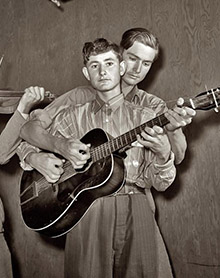


Gypsy Life: 1936
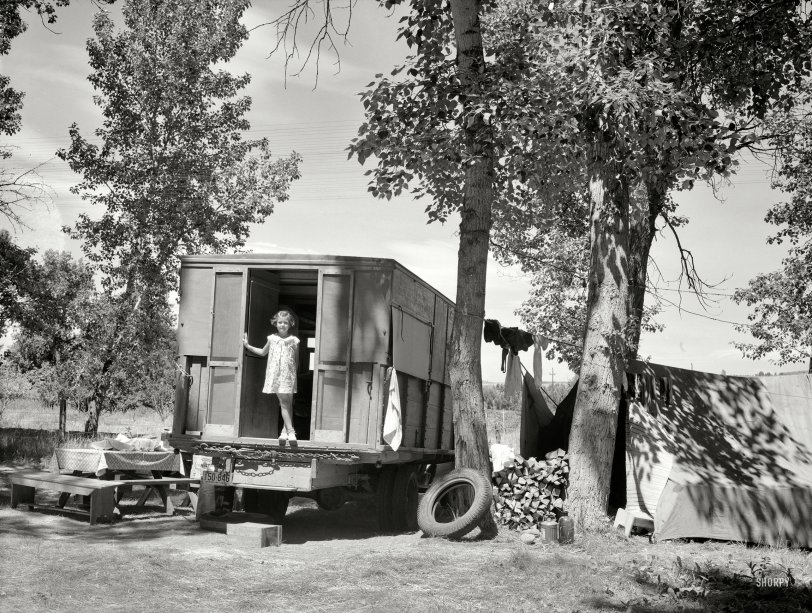
July 1936. "Child of migratory fruit workers from Missouri in Yakima, Washington." What will become of her? Medium-format nitrate negative by Arthur Rothstein for the Resettlement Administration. View full size.
Attitude
Just looking at her demeanor in this picture, she's looking directly at the camera, not trying to hide or turn away, I get the feeling that she's going to be OK.
Hopefully, in about 4 years, her family should have been able to escape the Depression and softened their hardscrabble existence. I guess we'll never know.

If there was a dinner bell
It'd probably be near to ringing. Looks to be about noon. A bucket of water will be put on the ground under that towel on the right corner of the truck so the workers can wash up a bit, and after the non-perishables are uncovered over there on the table, everyone'll grab a seat and have some grub. The little girl will make sure the water pitcher is full and ready. There won't be any ice, but the spring the water comes from delivers it cool and pure. Afterwards, the workers will enjoy a smoke and then it's back out under the July sun. The little girl will climb back up where we see her, and this moment will be preserved into the 21st Century.
What will become of her?
Unless Arthur Rothstein recorded her name we'll probably never know. My guess is she grew up, got a job in a war plant or maybe as a government girl in DC, then got married and raised a mess o' boomers. Sweet looking kid. I hope she had a happy life.
Gypsies
My mother always threatened to sell me to the Gypsies if I didn't straighten out, but I guess they wouldn't take me.
 Shorpy.com is a vintage photography site featuring thousands of high-definition images. The site is named after Shorpy Higginbotham, a teenage coal miner who lived 100 years ago. Contact us | Privacy policy | Accessibility Statement | Site © 2024 Shorpy Inc.
On Shorpy:
Today’s Top 5