


Framed or unframed, desk size to sofa size, printed by us in Arizona and Alabama since 2007. Explore now.
Shorpy is funded by you. Patreon contributors get an ad-free experience.
Learn more.



- Heckuva remote control!
- Sometimes — Things Go Bump!
- I SEE THE LIGHT
- Union Switch and Signal Company
- Get That Light Out Of My Eyes
- Eggs. Eggs. Eggs. The Egg Man is Here!
- Foreboding caption
- Famous Hollywood faces
- Not just S&P
- re: Those things in the jar
- Up In Smoke
- Medical Smoking
- Quick fix
- A Quink Comment
- If You’re Like Me, Never
- Delivering the News
- U.S.A.
- S&P
- 1940 Zenith radio model 6G601
- Quality goes in before the name goes on!
- Snazzy skirt
- Carbon Arc Lamps
- Illuminate us
- I remember it well
- I can't prove it
- Complicated then, forgotten now
- Bryan-Stevenson
- Skinny is as skinny does
- How do you rest in peace
- Riding the footboards
Photos submitted by Shorpy members!
Print Emporium

Twitter: 1921
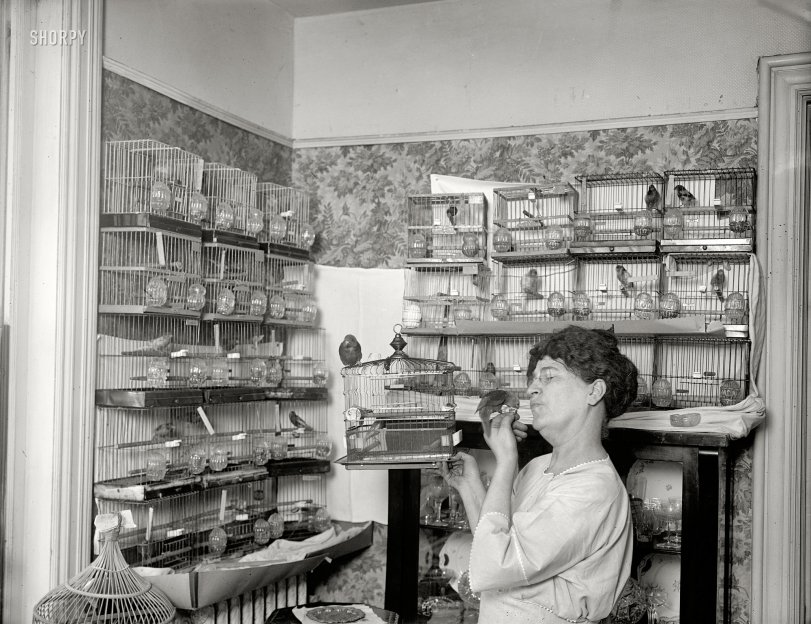
August 3, 1921. Washington, D.C. "Mrs. Jno. W. Clarke." Shown tweeting. National Photo Company Collection glass negative. View full size.
Intervention
Good thing that old broad is dead. I'd turn her in for hoarding.

Toasty Tweeters - Colorizing Chaos
Most hot-water radiator thermostats would probably be far too imprecise to properly regulate the heat and avoid a 'roast', so maybe that radiator went unused in the winter. Some of the birds look like lovebirds, others perhaps budgies or parakeets; what a challenge for someone intent on 'colorizing' the photograph!
Caption by Lewis Hine
January 15, 1920, Kanawha County, West Virginia: John "Tweety" Bird (left, age 8) and his brother James "Canary" (right, age 6), have been working in the safety division of the local mines, sniffing out lethal fumes, since they dropped out of the local school of music. Pictured with their boss, Mrs. William Pennypincher. An older brother Joe hasn't been seen in quite a while, but Mrs. Pennypincher tells the others not to worry.
I Tawt I taw a Puddy tat!
She looks like the prototype for Granny.
Poorly
So is that bird sick? Is she giving it tweetment?
Did Jno?
A Google search reveals that Jno is the abbreviation of the name John. What this accomplishes escapes me as when the obligatory period is included, no space has been saved. Perhaps some ink.
Question for bird fanciers
Come heating season, won't the tier of cages immediately above the radiator be too hot for safety?
 Shorpy.com is a vintage photography site featuring thousands of high-definition images. The site is named after Shorpy Higginbotham, a teenage coal miner who lived 100 years ago. Contact us | Privacy policy | Accessibility Statement | Site © 2024 Shorpy Inc.
On Shorpy:
Today’s Top 5